Beyond Ownership: What Will It Take for Worker Cooperatives to Thrive?
From financing and business succession to democratic governance and worker power, cooperatives offer a different approach to business ownership. But building a cooperative is only the beginning.
Across the country, interest in employee ownership—and specifically worker cooperatives—continues to grow. New York City has become an important center for worker cooperative development, bringing together a diverse network of businesses, cooperative developers, lenders, advocates, and public institutions working to expand opportunities for worker ownership.
In a city shaped by countless cultures, industries, and entrepreneurial traditions, worker cooperatives offer an opportunity to rethink some fundamental questions about business: Who makes decisions? Who benefits from a company's success? And who gets to build wealth through their work?
But as interest in worker ownership grows, another question deserves more attention:
What does it actually take for worker cooperatives to succeed as businesses?
That question is at the heart of the pilot episode of LevelUp Conversations, a new podcast series from The ICA Group.
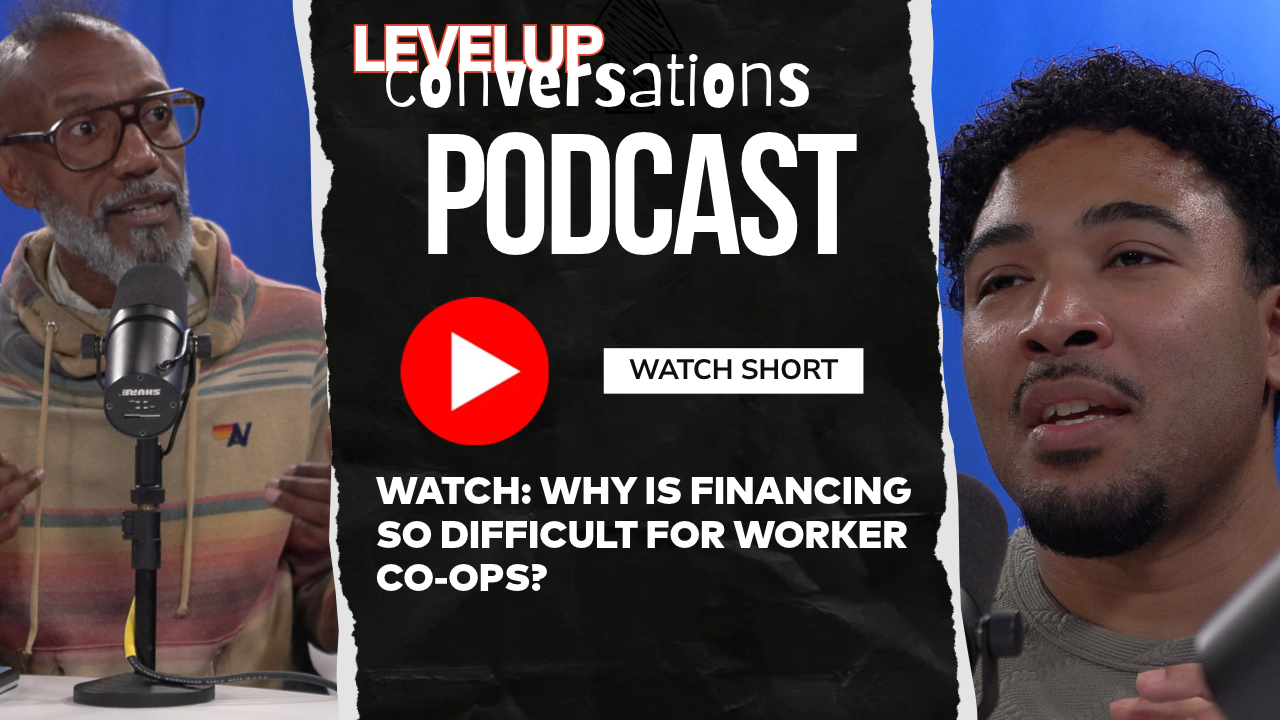
In The State of Worker Cooperatives: NYC & Beyond, ICA's Joél Mejia and Khalif Nunnally-Rivera explore the opportunities, challenges, and evolving infrastructure supporting worker ownership.
Their conversation moves between practical business challenges, cooperative development, and broader questions about economic democracy.
One theme emerges throughout: Expanding worker ownership requires more than helping people start cooperatives. It also means ensuring that existing worker-owned businesses have the resources, skills, and support necessary to remain competitive, financially healthy, and democratically governed.
WATCH: LevelUp Conversations — The State of Worker Cooperatives: NYC & Beyond
Worker Cooperatives Are Small Businesses, Too
It's worth starting with a basic point: Worker cooperatives operate differently from conventional businesses, but they aren't insulated from the economic pressures affecting the broader small business community.
They are still businesses.
Rising operating costs, commercial rents, access to financing, and the challenge of generating consistent revenue affect cooperatives just as they affect other small businesses.
What distinguishes worker cooperatives is how ownership, governance, and economic benefits are distributed.
Worker-owners may participate in financial decisions, elect leadership, develop policies, and collectively determine how the business distributes its earnings.
These democratic responsibilities can be significant strengths. But they also require skills that many workers have had few opportunities to develop in conventional workplaces.
A cooperative might have an excellent product, committed members, and a strong community mission. But without reliable financial systems, effective management, and clear decision-making processes, even a promising business can struggle.
Worker ownership changes who holds power within a business. It does not eliminate the need to run that business well.
In fact, it creates an opportunity to approach business management differently, by developing the capacity of workers to participate in decisions that have traditionally been reserved for owners and executives.
That brings us to one of the central challenges of cooperative development: preparing people not only to work in a business, but to own one.
What If Your Job Was Worth Owning?
In conventional workplaces, most workers exchange their labor for wages. They contribute their time, knowledge, and skills, but generally have limited influence over the larger decisions that shape their working conditions and the future of the business.
Worker cooperatives challenge that relationship.
Instead of separating the people who create value from those who control the business, cooperatives create opportunities for workers to share in ownership, decision-making, and the wealth their labor helps generate.
But becoming a worker-owner involves more than receiving a membership certificate or gaining voting rights.
It requires developing an ownership mentality.
During the conversation, Mejia raises a challenge familiar to many cooperative developers: Workers can understand the appeal of owning their jobs without necessarily having the experience or confidence to exercise that ownership.
After all, conventional workplaces rarely prepare employees to evaluate financial statements, make strategic decisions, manage competing priorities, or collectively determine how a business should operate.
For workers who have historically been excluded from opportunities to build wealth and exercise economic power, collective ownership can represent an especially significant shift.
That transformation doesn't happen automatically.
It takes education, practice, trust, and opportunities to participate meaningfully in decisions.
It also requires cooperative businesses to create structures that make democratic participation possible without sacrificing operational effectiveness.
Ownership is both a right and a responsibility. Developing the capacity to exercise it is part of the work of cooperative development.

Access to Capital Is Only Part of the Financing Challenge
Financing remains one of the most persistent challenges facing worker cooperatives.
Traditional lenders often evaluate small businesses through ownership structures and lending practices that do not always align with collective ownership.
Requirements such as personal guarantees can become particularly complicated when responsibility for a business is shared among multiple worker-owners.
A lender accustomed to working with a single business owner may not immediately understand how to evaluate a company governed collectively.
This creates challenges for otherwise promising businesses seeking working capital, equipment financing, or resources to expand their operations.
Fortunately, worker cooperatives are not limited to conventional bank financing.
Community development financial institutions and mission-aligned lenders, including organizations such as The Working World, the Cooperative Fund of the Northeast, and ICA's affiliated financing partner, the Fund for Jobs Worth Owning, have helped expand financing options for cooperative businesses.
These organizations recognize that cooperative businesses may require financing approaches that account for their ownership structures, governance practices, and broader social objectives.
But access to financing raises another important question:
Are cooperatives prepared to use capital effectively?
A business may qualify for financing and still lack the financial projections, cash flow management practices, or internal systems needed to make sound borrowing decisions.
And not every worker-owner is comfortable taking on debt.
For people who have experienced predatory lending, financial exclusion, or economic instability, borrowing can carry understandable concerns.
These experiences matter when discussing access to capital, particularly in communities that have historically faced barriers to conventional financial services.
This is where technical assistance becomes essential.
Cooperatives need opportunities to understand their financing options, evaluate the risks and benefits of borrowing, and develop business plans that reflect both their financial goals and cooperative values.
The objective isn't simply to help more cooperatives secure loans.
It's to help worker-owners make informed decisions about when financing makes sense, how much capital their businesses need, and how those resources can support long-term sustainability.
Capital is a tool. Knowing when and how to use it is a business skill.
Business Succession Is an Opportunity to Preserve Local Ownership
Worker cooperatives are also part of a larger conversation about what happens when small business owners retire.
Across the country, many owners face difficult decisions about succession. Without a viable transition plan, some businesses may close, while others may be sold to outside buyers.
For communities that rely on locally owned businesses for jobs, services, and neighborhood identity, these transitions can have consequences that extend well beyond the individual business.
Employee ownership offers another possibility: selling a business to the people who already help make it successful.
For retiring owners, this can provide an opportunity to preserve their legacy.
For employees, it can create a pathway to business ownership and wealth building.
For communities, it can help preserve jobs, maintain local economic relationships, and keep businesses rooted in the neighborhoods they serve.
This possibility becomes particularly important as communities consider the growing influence of outside investors and the consolidation of locally owned businesses.
Not every business will be a good candidate for conversion to worker ownership. Successful transitions require financial feasibility, employee interest, appropriate financing, and careful planning.
But for businesses that are good candidates, employee ownership can offer an alternative to closure or acquisition by outside investors.
During the conversation, Khalif discusses how cooperative development can help address business succession challenges while strengthening local economies.
The opportunity is not simply to create more cooperatives. It's also to preserve existing businesses and expand who has the opportunity to own them.
New York City's Cooperative Ecosystem Offers an Important Lesson
One of the reasons New York City has become an important center for worker cooperative development is the infrastructure supporting the movement.
Through the Worker Cooperative Business Development Initiative (WCBDI), funded by the New York City Council and administered by NYC Small Business Services, organizations across the city provide education, technical assistance, and other support to aspiring and existing worker cooperatives.
The initiative recognizes that developing worker-owned businesses requires more than encouraging entrepreneurship.
It requires an ecosystem.
Cooperative developers help businesses evaluate ownership structures and strengthen their operations. Legal service providers support incorporation, bylaws, and governance. Mission-aligned lenders help businesses navigate financing. Membership and advocacy organizations connect worker-owners and amplify their collective voice.
Organizations such as the NYC Network of Worker Cooperatives also play an important role in building relationships among cooperatives and advocating for policies that support the movement.
These institutions serve different functions, but together they create opportunities for worker-owned businesses to access support that would otherwise be difficult to navigate individually.
The ICA Group has participated in WCBDI since 2015, providing cooperative development services and education to businesses and worker-owners across New York City.
Through programs such as LevelUp Coops, ICA works to make cooperative business education more accessible while addressing the practical challenges that arise as businesses grow.
The larger lesson extends beyond New York City.
If communities want more worker-owned businesses, they also need to invest in the infrastructure that helps those businesses succeed.
That includes financing, technical assistance, education, legal services, and opportunities for cooperatives to build relationships with one another.
The cooperative movement cannot depend exclusively on the determination of individual entrepreneurs. Sustainable growth requires institutions that support worker ownership over time.
Worker Ownership, Worker Power, and the Broader Economy
As the conversation moves beyond New York City, another question emerges: What role can worker cooperatives play in strengthening the broader labor movement and building economic democracy?
Worker ownership and labor organizing are sometimes discussed as separate approaches to improving working conditions.
But they can also reinforce one another.
Ownership provides workers with opportunities to participate in governing their businesses and sharing in their economic success.
Labor organizing can provide additional protections, collective bargaining power, and connections to a broader movement for workers' rights.
These approaches are not necessarily in conflict.
A worker cooperative may have employees who are not yet members, workers who choose not to pursue ownership, or different management responsibilities within the business.
Democratic ownership does not automatically eliminate workplace power imbalances or the need for worker protections.
In the episode, Nunnally-Rivera discusses the relationship between unions and employee ownership, including the role of the United Steelworkers in supporting union cooperative models.
The conversation also considers how democratic participation in the workplace can help workers develop skills that extend into their communities.
Learning to deliberate, evaluate competing priorities, participate in governance, and make collective decisions can strengthen people's capacity to engage in other democratic institutions.
This points toward a broader understanding of cooperative development.
The goal is not simply to create businesses that distribute profits differently.
It is to build institutions where workers have greater opportunities to exercise economic and democratic power.
Beyond Ownership: Building Cooperatives That Last
Worker cooperatives offer an opportunity to rethink how businesses distribute ownership, wealth, and decision-making power.
But ownership alone does not guarantee success.
Cooperatives still need strong financial systems, effective management, sustainable business models, and the ability to adapt to changing economic conditions.
They also need something that conventional business development programs do not always prioritize: ongoing opportunities for workers to develop the skills and relationships necessary to govern their businesses democratically.
These are not competing priorities.
A financially healthy cooperative is better positioned to create lasting economic opportunities for its members. A cooperative with meaningful democratic participation can draw on the knowledge, experience, and commitment of the people who make the business work.
Building successful worker cooperatives requires taking both sides of that equation seriously.
And it requires recognizing that cooperative development doesn't end when a business becomes worker-owned.
In many ways, that's when another important phase begins.
Introducing LevelUp Conversations
LevelUp Conversations builds on The ICA Group's LevelUp Coops educational programming by creating space for accessible discussions about the realities of worker ownership.
Rather than approaching every topic as a formal workshop, the series brings together cooperative practitioners, worker-owners, and others working to build a more democratic economy.
Our pilot episode, The State of Worker Cooperatives: NYC & Beyond, is an invitation to explore some of the questions shaping the movement today.
What does it take to build a financially sustainable cooperative? How can communities strengthen their cooperative ecosystems? And how do we help workers develop the capacity to exercise ownership meaningfully?
We don't expect to answer every question in a single conversation.
But we believe these are conversations worth having.
Watch the full pilot episode of LevelUp Conversations and help us shape what comes next.
What challenges are you navigating in your cooperative? What topics should we explore next?
We'd love to hear from you.

Interview multiple candidates
Lorem ipsum dolor sit amet, consectetur adipiscing elit proin mi pellentesque lorem turpis feugiat non sed sed sed aliquam lectus sodales gravida turpis maassa odio faucibus accumsan turpis nulla tellus purus ut cursus lorem in pellentesque risus turpis eget quam eu nunc sed diam.
Search for the right experience
Lorem ipsum dolor sit amet, consectetur adipiscing elit proin mi pellentesque lorem turpis feugiat non sed sed sed aliquam lectus sodales gravida turpis maassa odio.
- Lorem ipsum dolor sit amet, consectetur adipiscing elit.
- Porttitor nibh est vulputate vitae sem vitae.
- Netus vestibulum dignissim scelerisque vitae.
- Amet tellus nisl risus lorem vulputate velit eget.
Ask for past work examples & results
Lorem ipsum dolor sit amet, consectetur adipiscing elit consectetur in proin mattis enim posuere maecenas non magna mauris, feugiat montes, porttitor eget nulla id id.
- Lorem ipsum dolor sit amet, consectetur adipiscing elit.
- Netus vestibulum dignissim scelerisque vitae.
- Porttitor nibh est vulputate vitae sem vitae.
- Amet tellus nisl risus lorem vulputate velit eget.
Vet candidates & ask for past references before hiring
Lorem ipsum dolor sit amet, consectetur adipiscing elit ut suspendisse convallis enim tincidunt nunc condimentum facilisi accumsan tempor donec dolor malesuada vestibulum in sed sed morbi accumsan tristique turpis vivamus non velit euismod.
“Lorem ipsum dolor sit amet, consectetur adipiscing elit nunc gravida purus urna, ipsum eu morbi in enim”
Once you hire them, give them access for all tools & resources for success
Lorem ipsum dolor sit amet, consectetur adipiscing elit ut suspendisse convallis enim tincidunt nunc condimentum facilisi accumsan tempor donec dolor malesuada vestibulum in sed sed morbi accumsan tristique turpis vivamus non velit euismod.

Joél Mejia
Business Developer